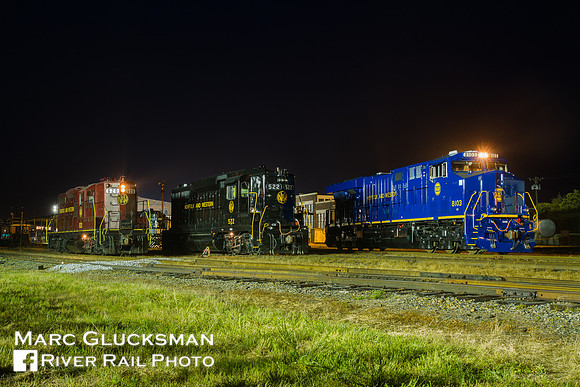
NW. What began with the formation of the City Point Railroad in Virginia in 1838 would later become part of the 1881 renamed Norfolk and Western Railway. Earning its nickname of “King Coal”, which was staple of its freight business, it would continue to grow as a company by purchasing or merging with other large railroads. In 1982, it would join with the Southern Railway to form Norfolk Southern Corp as a holding company. For the 30th Anniversary, an event was held at the N.C. Transportation Museum in Spencer, North Carolina with its 20 newly painted "heritage units”. On the night of July 3, 2012, the “N&W Family Portrait” was posed, including Norfolk Southern 8103 (Norfolk & Western Heritage, ES44AC) along with
Virginia Museum of Transportation Norfolk & Western 522 (GP30) and the museum’s own Norfolk & Western 620 (GP9).
Yes, it has been 10 years. On July 3, 2012, along with thousands of others over the next few days, I made my first visit to the N.C. Transportation Museum for a once in a lifetime event. Norfolk Southern Corp worked with the museum to bring its 20 newly painted "heritage units" to Spencer, North Carolina and put on a memorable event for the public in honor of the 30th Anniversary of the Norfolk & Western and Southern Railways joining to become NS. The name was taken from the the former Norfolk Southern Railway, which was acquired by Southern in 1974. Ironically, while Southern was the first major railroad to fully dieselize their roster in 1953, N&W was the last to depart from steam in 1965. N&W would join Amtrak upon its inception in 1971, the Southern not until 1979. But whatever their previous differences, the formation of the CSX Corporation was a sign of consolidation to come and the partnership was formed.
What is now the N.C. Transportation Museum was once a shop of the Southern Railway. The scheduled events began with a night shoot, with various units being moved around the museum and later back to the turntable.